

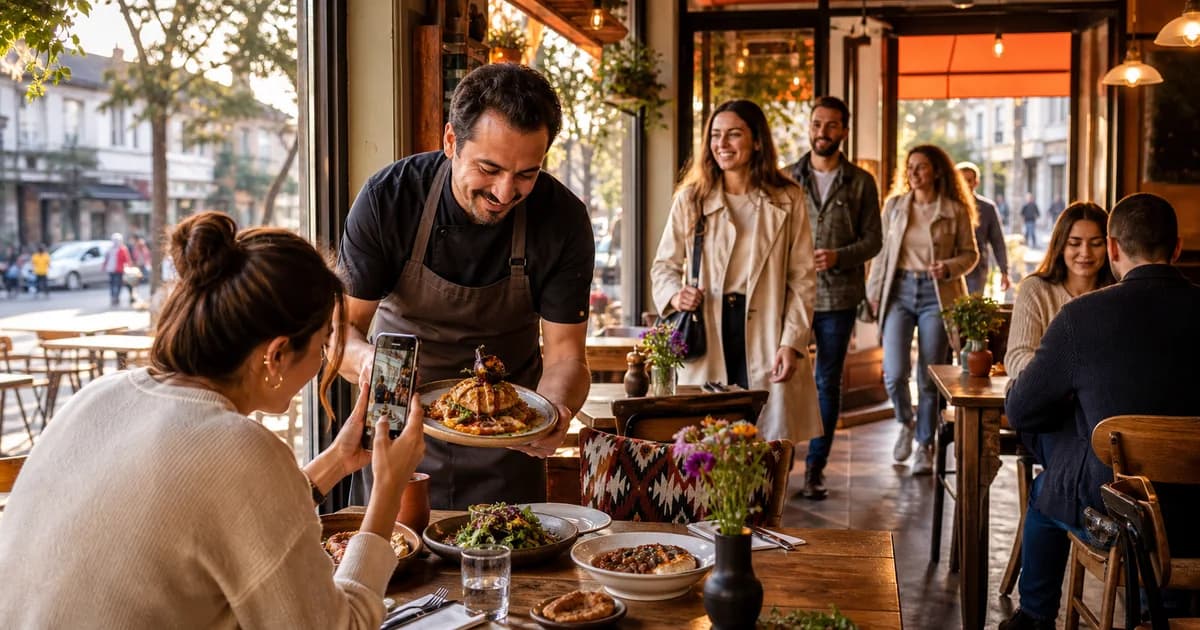
Turn local discovery, trust, reservations and creator experiences into a measurable customer-acquisition system for a new cafe or restaurant.
The most dependable way for a new cafe or restaurant to attract customers is to become complete and accurate in local search, create a frictionless path from menu discovery to reservation, and connect local creator experiences with available table periods and verified visit outcomes. First validate the address, opening hours, menu, price context and booking link. Then test why someone should choose the venue through authentic creator narratives. Content alone cannot guarantee occupancy. When product, service, location, capacity and repeat visits are managed together, however, the business can see which demand creates value.
Diagnose the journey at five stops
Before deciding to “post more,” identify where the customer path breaks. Select a fixed period, such as the last 14 or 28 days, and review each stop over the same dates:
- Discovery: Is the Google Business Profile complete with the correct category, address, phone, hours, website and current photography? Does the map pin indicate the real entrance?
- Fit: Can a guest easily find the menu, useful price context, cuisine type, allergen communication, accessibility and relevant child or pet policies?
- Trust: Do visuals represent the actual venue, portion and service format? Are questions and reviews answered calmly without exposing personal information?
- Conversion: Is there an obvious next step for calling, directions, table booking or ordering? Does the mobile destination work and show accurate availability?
- Operations and return: Can the kitchen, floor plan and service team handle demand caused by content? Is there a permission-based route to a repeat visit after good service?
High profile activity with few bookings does not necessarily mean the content failed. The menu may be unclear, a booking link may be broken or hours may be wrong. If bookings are strong but attendance is weak, inspect reminders and cancellation handling. If feedback deteriorates while volume rises, fix capacity and service quality before increasing creator volume.
Connect local discovery to the decision
Google's restaurant Business Profile features support the management of menus, photos, opening hours, service options and, where available, booking or ordering links. Every element should agree with the website, booking system and actual venue operation. Update special hours; do not claim a service option you do not provide; and avoid continually featuring a signature dish that is unavailable.
Local business links may support a preferred link, but providers and regional availability can change. Do more than add the URL: open it on a phone, verify the branch, complete a test booking and inspect confirmation. A creator's bio or story link should lead to the same verified destination.
State the venue proposition in one sentence. “The city's best” is neither supportable nor distinctive. Explain who should visit, for which occasion and why: a quick weekday lunch, quiet work tables, a shareable seasonal menu or transparent information for a specific dietary need. Every claim must be supported by real operations.
Make creators part of local demand research
Do not choose a local creator by follower count alone. Audience interest in the city or neighbourhood, topic fit, locally relevant comments, previous commercial disclosure, filming style and compatibility with venue capacity matter more. A creator who genuinely uses the area and can explain a decision occasion may be a better hypothesis than a large but dispersed audience; it is still a hypothesis to test, not a guaranteed result. The micro-influencer discovery guide offers a selection framework.
Instead of giving everyone the same script, ask three distinct questions:
- For which visit occasion is this place useful?
- What made the menu decision easy or difficult?
- Did location, seating, service time and booking match the expectation?
Do not launch if the business cannot accept an honest answer. Content should represent the real portion, that day's experience and current price context without deception. Establish consent and privacy controls if customers, children, staff or private conversations could appear in footage.
An actionable EXPERIENCE campaign example
Imagine a new neighbourhood restaurant that wants to use a quiet weekday period between 15:00 and 17:00. It designs booked “seasonal menu discovery” sessions for six local creators who resemble intended guests. Every session has the same welcome, two small tastings, menu story and booking-path experience. Creators receive three possible editorial angles, but there is no positive-review, star-rating, scripted-praise, sales or reservation requirement. Allergens, filming limits, disclosure and usage rights appear in the written brief.
The current Influencer Marketplace Free brand plan allows one active campaign. An EXPERIENCE campaign carries no creator cash payment, shipped product or sales commission. Nevertheless, the meal and venue experience can be commercial consideration, while ingredients, staff, table capacity, cleaning, energy and coordination are real business costs. Do not assume an unused table is costless. Confirm entitlement and current conditions on the pricing page before launch.
Separate the delivery date, disclosure, organic publishing, brand reuse and any paid-media permission in the brief. The brand–creator brief guide provides practical checkpoints.
Sequence content tests around capacity
Do not invite every creator on the same day in week one. Use two or three small waves. The first might test “a new neighbourhood option,” the second a specific visit occasion, and the third content that makes menu choice easier. Change the creative angle while keeping the booking page, core offer and measurement window as stable as possible.
Classify recurring questions after posts: price, transport, parking, vegan choices, allergens, booking, hours or crowds. These are not merely engagement; they may reveal missing information in the profile or website. Verify the answer and update the appropriate page. Align publishing and promotion with actual table capacity instead of stimulating heavy demand in periods the venue cannot serve.
Measurement table: visit quality, not just visibility
| Stage | Measure | Definition | Business decision |
|---|---|---|---|
| Local discovery | Profile actions | Track menu, website, call, directions and booking actions by available source | What information is the profile missing? |
| Traffic | Creator-attributed booking sessions | UTM-tagged visits after bot and team traffic are removed | Which story creates qualified intent? |
| Booking | Completed booking rate | Completed bookings / booking-page sessions | Where is the friction? |
| Visit | Attendance rate | Attended reservations / confirmed reservations | Do reminders and cancellations work? |
| Revenue | Average bill and net contribution | Assess completed bills with discounts, ingredients, staff and campaign cost | Does demand become profitable capacity? |
| Experience | Complaint and feedback themes | Classify service, food, wait and expectation fit | What must operations improve? |
| Repeat | Permission-based return signal | A verified later visit or booking by the same guest | Does the experience support sustainable loyalty? |
Do not count everyone presenting a code as a new customer; separate team, creator and existing customers where possible. Do not attribute all value to the final click. Source definitions, date range, cancellation correction and operating cost should be visible in the report. The campaign measurement guide helps establish a shared metric language.
Pre-publish checklist
- Google Business Profile name, category, pin, phone, opening hours and special hours are correct.
- Menu, price context, allergen communication, service options and accessibility information are current.
- Booking, call, directions and website links have been tested on a real phone.
- Local and topic fit of the creator audience is documented without false certainty.
- Disclosure, filming consent, guest privacy and usage rights are written down.
- Tasting capacity accounts for kitchen, floor team, cleaning and regular guests.
- UTM structure, codes, reservation source, report period and cancellation/no-show adjustment are ready.
- There is an owner for verifying, answering and correcting negative feedback rather than hiding it.
Frequently asked questions
Should a new restaurant prepare social media or its Google profile first?
They support different moments and should be prepared together. Social content shows the experience and story; the Google profile verifies address, hours, menu and actions during high-intent local search. Interest may be lost if the profile and booking link do not work before creator publishing starts.
Is it acceptable to ask a creator for a positive review or five stars?
No. Do not make a positive opinion, rating or guaranteed reservation a condition of an invitation or experience. The creator should disclose the commercial relationship and remain free to report the authentic experience. Treat an operational problem as information to investigate and correct.
Is an EXPERIENCE campaign genuinely free?
The current Free brand plan includes one active campaign, while the EXPERIENCE type attaches no cash, shipped product or sales commission to the creator. The meal and venue can still be consideration; ingredients, table capacity, labour and coordination cost the business. Verify the current plan on the pricing page and do not present the complete activity as “zero cost.”
Legal and ethical note
A meal, invitation or privilege offered to a creator can establish a commercial connection and may require clear advertising disclosure. Never require positive feedback, a rating, reservations or guaranteed sales, and do not permit misleading claims about price, portion, ingredients, allergens or health. Protect customer and employee privacy, personal data, and music and visual rights. Review category-specific rules for areas such as alcoholic drinks, health claims and communication aimed at children. Check the Ministry of Trade's current guidance before publishing in Türkiye. This article is not legal advice.
Create a free brand account on Influencer Marketplace and plan your local creator experience as a measurable campaign.
Primary sources
- Google Business Profile Help — Manage your restaurant profile
- Google Business Profile Help — Manage local business links
- Meta for Business — Instagram Creator Marketplace
- Republic of Türkiye Ministry of Trade — Guideline on commercial advertising by social media influencers
- Republic of Türkiye Ministry of Trade — Türkiye E-Commerce Outlook Report 2025