

Manage hotel occupancy and direct booking as distinct goals, then measure Google visibility, booking experience and creator content through net contribution.
To increase hotel occupancy and direct bookings, manage them as two distinct outcomes: first make the right room and experience visible for the right dates, then move demand to the direct channel through current rate and availability information plus a frictionless mobile booking path. Creator content can demonstrate who the property suits, for which travel occasion and why through a real stay, but it cannot guarantee occupancy or sales. Success becomes visible when room availability, rate integrity, booking conversion, cancellation, channel cost and guest experience appear in the same report.
Do not confuse occupancy with direct booking
Occupancy is rooms sold divided by rooms available for sale. Direct booking share is verified direct room bookings divided by all verified bookings. A hotel may improve occupancy through intermediary channels without changing direct share; direct share may rise while poor pricing or high cancellation weakens net contribution. Do not leave the campaign objective as the vague phrase “more bookings.”
Choose one priority for each date range and segment. For a city hotel with weak weekdays, verified direct room nights may be appropriate. For a boutique hotel already full on summer weekends, longer stays or a healthier channel mix may matter more. The same creative will not necessarily produce the same result in every period because availability and travel intent change.
Diagnose booking leakage at seven points
Choose a recent comparable period before searching for creators and review:
- Discovery: Does the Google hotel profile show the correct name, category, phone, location, photography and property information?
- Rates and availability: Are direct dates, room types, taxes or fees and cancellation terms current? Does the booking link shown on Google lead to the right property?
- Product clarity: Are room size, bed arrangement, view, breakfast, accessibility, parking, child and pet conditions clear?
- Mobile conversion: Can a real user complete the journey from date selection to payment on a phone? Do language and currency fit the guest context?
- Trust: Do photography and creator stories represent the actual room category, location and service boundaries?
- Operations: Do confirmation, pre-arrival communication, reception, housekeeping and special-request owners use the same facts?
- Net outcome: Does reporting include cancellations, refunds, channel fees, creator experience and operating cost?
Strong Google profile activity but weak booking-site visits may indicate an unclear offer or link. Site traffic without date searches may mean content fails to establish a travel occasion. Date searches without payment can indicate price opacity, a mobile defect or lack of trust. Bookings followed by heavy cancellation may mean the story and page set the wrong expectation.
Correct the Google hotel visibility foundation
Google's hotel Business Profile guidance covers accurate property information, category, amenities and ownership. Hotel details can be assembled from several Google sources, so correcting an error only on social media is insufficient; use the applicable official correction process. Label photography by the real room category and remove amenities the property no longer provides.
Google free booking links may send eligible traffic to the official hotel site when technical and participation requirements are satisfied. Rates and availability must be accurate, while the landing page should preserve the selected hotel, dates, language and currency context. Eligibility can vary by country, system and integration, so do not assume that a free booking link is automatic or universal. Verify current requirements in official documentation and test with the booking-engine provider.
Do not market the direct channel with an unverifiable absolute such as “always the cheapest.” State the real advantage: a flexible condition, specific package, direct support or a verified on-property benefit. Do not reveal mandatory taxes or fees as a late surprise.
Design creator content around a travel occasion
“Promote our hotel” is too broad a brief. Give the creator a concrete decision question. Business travel may focus on transport, a workspace and efficient check-in; a weekend may focus on a walkable route; a family stay may require accurate bed configuration and property rules; a food trip may explore breakfast and the neighbourhood. Prove one travel occasion rather than listing every amenity in one asset.
Review creator audience interest from the target market, travel style, narrative quality, disclosure history, seasonal fit and ability to answer real booking questions. Follower count alone does not demonstrate room demand. The creator commerce guide explains how content can be connected to a decision without pretending that exposure equals a sale.
The brief should record the room category to be filmed, accessible areas, included services, separation between personal experience and property claims, disclosure, delivery and content rights. Do not bundle organic publishing, reuse by the hotel and paid-media permission into one assumed consent. Separate duration, territory, channels and editing. The brand collaboration brief guide helps build this pre-production framework.
An actionable EXPERIENCE campaign example
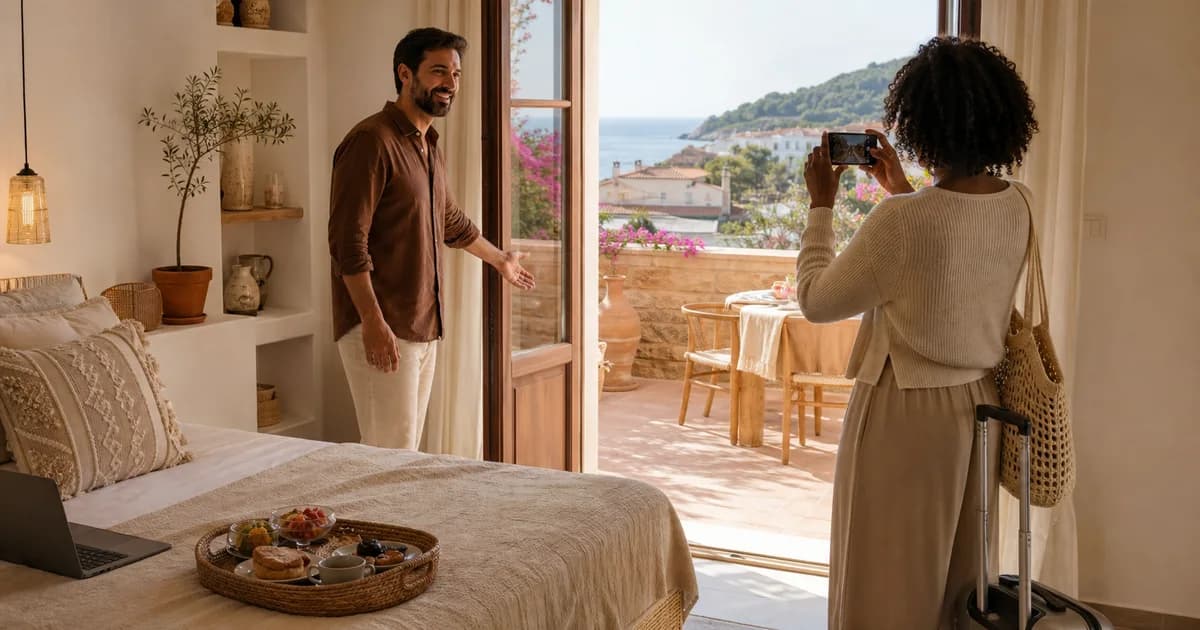
Imagine a central city hotel that wants to develop verified direct room nights from Sunday to Thursday. It opens separate one-night experiences for three creators who cover business travel, cultural itineraries and short city breaks. Each sees a room category that is genuinely for sale to the intended segment rather than an unrepresentative suite. A creator chooses one primary angle from transport and check-in, the room and breakfast, or the surrounding itinerary. There is no positive-review, five-star, occupancy, booking or sales requirement. Private zones and other guests remain protected.
The current Influencer Marketplace Free brand plan allows one active campaign. An EXPERIENCE campaign gives the creator no cash payment, shipped product or sales commission. Yet the stay, breakfast or property access can be consideration in a commercial relationship, while sellable inventory, housekeeping, laundry, food and beverage, energy, reception and coordination are real business costs. Even a low-demand room is not costless. Confirm current plan conditions on the pricing page, and never use “free” to imply that the complete activation has zero cost.
Give each creator a UTM-tagged direct booking link, an identifiable and truthful campaign code where suitable, and the same reporting window. Do not attribute every booking that displays a code to the creator without examining booking time, stay date, cancellation and source evidence. The influencer sales tracking guide explains the limits of links and codes.
Measurement table: from rooms to net contribution
| Area | Measure | Formula or definition | What it explains |
|---|---|---|---|
| Capacity | Occupancy | Rooms sold / rooms available for sale | Capacity use for the dates examined |
| Room revenue | ADR | Room revenue / rooms sold | Average room revenue for each room sold |
| Capacity revenue | RevPAR | Room revenue / rooms available for sale | Rate and occupancy on one capacity base |
| Channel | Direct booking share | Verified direct bookings / all verified bookings | Movement in channel mix |
| Conversion | Booking-engine conversion | Completed direct bookings / qualified booking sessions | Whether the mobile path converts demand |
| Quality | Net stayed room nights | Realised room nights after cancellations and refunds | Whether content established accurate expectations |
| Economics | Net contribution | Net revenue minus channel, creator, media, room and operating costs | Whether responsible scaling makes sense |
Do not attribute every change in ADR or RevPAR to the creator. Pricing, calendar, events, capacity and other channels affect the result. Compare similar dates and segments where possible, and disclose differences outside the test's control. Report organic creator publishing, hotel reuse and paid distribution separately. The influencer ROI guide provides a wider measurement framework.
Implementation checklist
- Hotel name, location, phone, category, photography and amenities are correct on Google.
- Direct rate, availability, taxes or fees, room type and cancellation terms are verified on a real device.
- The booking link preserves the selected hotel, dates, language and currency context.
- Each creator is matched to one travel occasion and target segment.
- Room, service, neighbourhood and accessibility claims are current and verified.
- Disclosure, guest privacy, filming boundaries and usage rights are documented.
- UTM, code, measurement window, cancellation/refund and channel-cost reporting are ready.
- EXPERIENCE cost includes room opportunity, housekeeping, breakfast, energy, staff and coordination.
- Reservations, reception and customer service can access the same campaign facts when demand arrives.
Frequently asked questions
Should a hotel improve occupancy or direct booking share first?
The answer depends on dates and business economics. A low-demand period may prioritise realised room nights; on dates that already fill, channel cost or stay value may matter more. Choose one primary objective for a defined period and segment, then use the other measures as guardrails.
Is a complimentary creator stay advertising?
A stay or access can be consideration in a commercial relationship. The creator should disclose the advertising nature clearly; the hotel cannot require a positive opinion or booking guarantee. Document the included stay, disclosure, content rights, privacy and personal-data rules.
Is an EXPERIENCE campaign genuinely free?
The current Free brand plan includes one active campaign, while EXPERIENCE attaches no cash, shipped product or sales commission to the creator. Rooms, cleaning, breakfast, energy, staff time and coordination still cost the business, and the stay can be consideration. Verify current conditions on the pricing page and do not present the entire activation as zero-cost.
Legal and ethical note
A stay, meal, event or privileged access provided to a creator may establish a commercial connection and should be disclosed clearly. Do not demand a positive review, five stars, guaranteed occupancy, bookings or sales. Never misrepresent room, view, price, availability, accessibility or included service. Protect other guests' images, booking information and personal data, as well as music, photography and content rights. Review special rules involving children, alcohol, health or wellness services and promotions. Check the Ministry of Trade's current guidance before publishing in Türkiye. This article is not legal advice.
Create a free brand account on Influencer Marketplace and plan a measurable creator experience for your hotel.
Primary sources
- Google Business Profile Help — Get started with a hotel Business Profile
- Google Hotel Center Help — Free booking links
- Google Hotel Center Help — Free booking link best practices
- TikTok for Business — Travel advertising guide
- Republic of Türkiye Ministry of Trade — Guideline on commercial advertising by social media influencers