

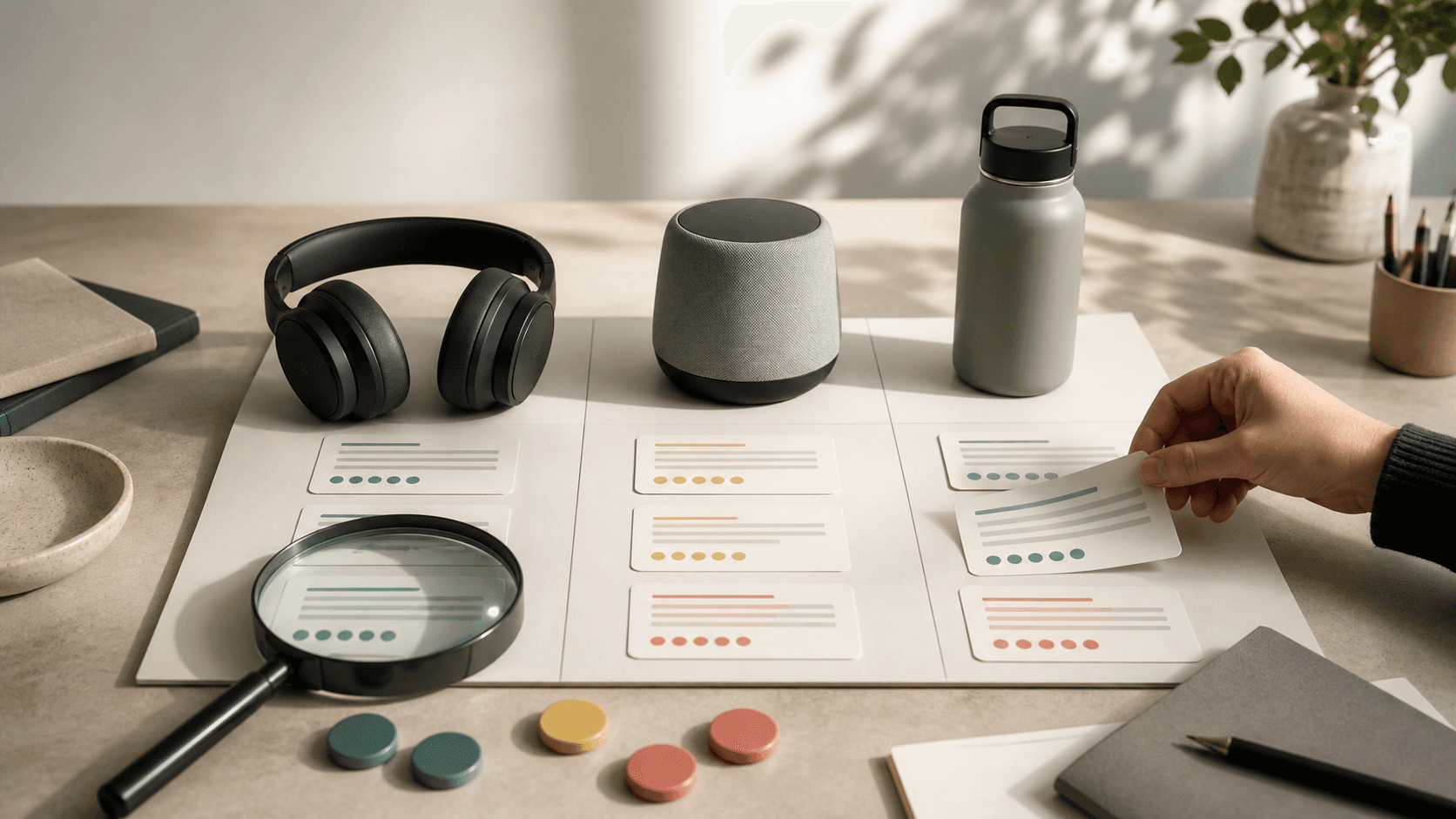
Analyse competitor reviews ethically and accurately: separate access coverage from real text evidence, prove strengths and gaps, and turn findings into product and UGC actions.
To analyse competitor product reviews properly, first record which data you could access, under which permission and on which date; then code only the real review text into decision themes, compare competitors on specific dimensions, and turn each finding into a product or UGC action with an owner and a success signal. Two mistakes make an analysis worthless: scraping a platform's closed endpoints without permission, and inventing review themes from an aggregate star rating.
Competitor reviews can be strong evidence of the language customers use to make decisions. Professional product intelligence starts by showing exactly what evidence it is built on.
Separate the four access states
Every product source falls into one of four states. Label each one explicitly:
| State | What exists | What you can do |
|---|---|---|
| EMBEDDED_STRUCTURED | Real review bodies in the main product document | Theme and evidence analysis |
| AGGREGATE_ONLY | Rating and review count, but no text | Use as a trust signal; themes cannot be extracted |
| NOT_EXPOSED | No structured review evidence | Report the data gap |
| APPROVAL_REQUIRED | The full corpus depends on business or licence permission | Apply officially or use a licensed data provider |
This distinction tells the user "this is the legal and technical scope of this source", not "the system failed". A missing corpus should never be presented as a failed analysis or, worse, as a fabricated sentiment result.
What the main product document can tell you
On a public product page where access is permitted, Product JSON-LD or visible metadata may provide the product name, brand, SKU or GTIN, images, price, currency, availability, aggregate rating and sometimes embedded reviews. Store every field with its source URL and fetch time, so anyone reading the report can see where and when each value came from.
Going directly to internal /yorumlar (reviews), /product-comment, /api or /rest endpoints, or bypassing robots directives, sessions, CAPTCHAs or rate limits, is not production quality. It produces unstable, risky and unauditable data, and it can break at any moment.
How to extract review themes
First, minimise personal data: do not carry the reviewer's name into the analysis output. Then code each review body into themes that matter for a product decision:
- Product performance and expectations
- Size, fit, texture or colour
- Setup and ease of use
- Packaging and delivery
- Durability and repeat use
- Price-to-value perception
- Return reasons or wrong variant
For each theme, keep a short paraphrased piece of evidence, its direction (positive, mixed or negative) and the real number of mentions. If the sample is small, do not produce precise percentages. A handful of loud reviews may not represent the whole customer base, and a report that turns a few comments into a confident percentage does more harm than good.
Prove competitor strengths and weaknesses
Instead of writing "the competitor is strong", pick a dimension and compare on it:
- Offer clarity
- Quality of visual proof
- Answers to usage questions
- Price and bundle value
- Stock and variant visibility
- Real review coverage
- SEO product data
Not every comparison has a winner. If the evidence is missing, the winner field should stay empty (for example winnerSourceId = null) with the explanation "insufficient evidence". This stops an AI model, or an analyst under pressure, from forcing a conclusion into every row.
Turn insight into product and UGC actions
Review analysis should not stay in a slide deck. Each theme becomes an action with an owner and a success signal:
| Evidence | Action | Measurement |
|---|---|---|
| Unclear sizing | Scaled images plus a creator demo | Return reasons, product page conversion |
| Difficult setup | Uncut setup video | Support questions, completion |
| Damaged packaging | Packaging test | Damaged-delivery rate |
| Value objection | Proof of bundle contents and difference | Add-to-cart, contribution |
| Wrong expectations | Fix title, images or brief | Returns and negative themes |
In the UGC brief, do not simply repeat the competitor's weakness. First confirm that your own product genuinely delivers on the claim you want creators to make.
What official seller APIs provide
In Türkiye, the Trendyol, Hepsiburada and n11 developer portals (Trendyol Developers, Hepsiburada Developers, n11 Developers) offer APIs for an authorised seller's own operations, which vary across products, stock, price, orders and customer questions. They are not a key to a competitor's private review data. Keep your own store data as canonical business data, and keep competitor public-document data separately with its own provenance.
A quality gate before you publish the report
Before the report goes out, check the source identity, evidence time and access scope of every finding:
- A review theme must rest on at least one real review body; for a product with only an aggregate rating, the theme list stays empty.
- Price comparisons must normalise the same bundle and variant, and give no result if the currency is unclear.
- If a product page could not be fetched, show the error time and provider status instead of passing off an old cache as current.
- Never end with a generic recommendation such as "improve the product". Add an owner, an action, a success signal and a date for re-measurement.
Frequently Asked Questions
Is scraping completely forbidden?
Fetching a public document while respecting robots rules, terms of use, rate limits, personal data, copyright and SSRF security is not the same as bypassing closed endpoints. Each source needs its own legal and technical assessment.
Is a product with a higher rating the better product?
Not necessarily. A rating is shaped by sample size, category, price and customer expectations. On its own it is not proof of product quality or of sales.
Can I use competitor reviews on my own website?
Processing reviews for analysis does not give you the right to republish the text. Google also asks sites not to aggregate other websites' ratings in their own structured data; see Google Search Central's review snippet guidance.
What should I do when a marketplace only shows an aggregate rating?
Label the source AGGREGATE_ONLY, use the rating as a trust signal and leave the theme list empty. For the full review corpus you need official business access or a licensed data provider.
Open Product Intelligence to compare your own product with competitor links from Trendyol, Hepsiburada, n11 or your own site, with access coverage labelled and UGC and product actions drawn only from real evidence.