

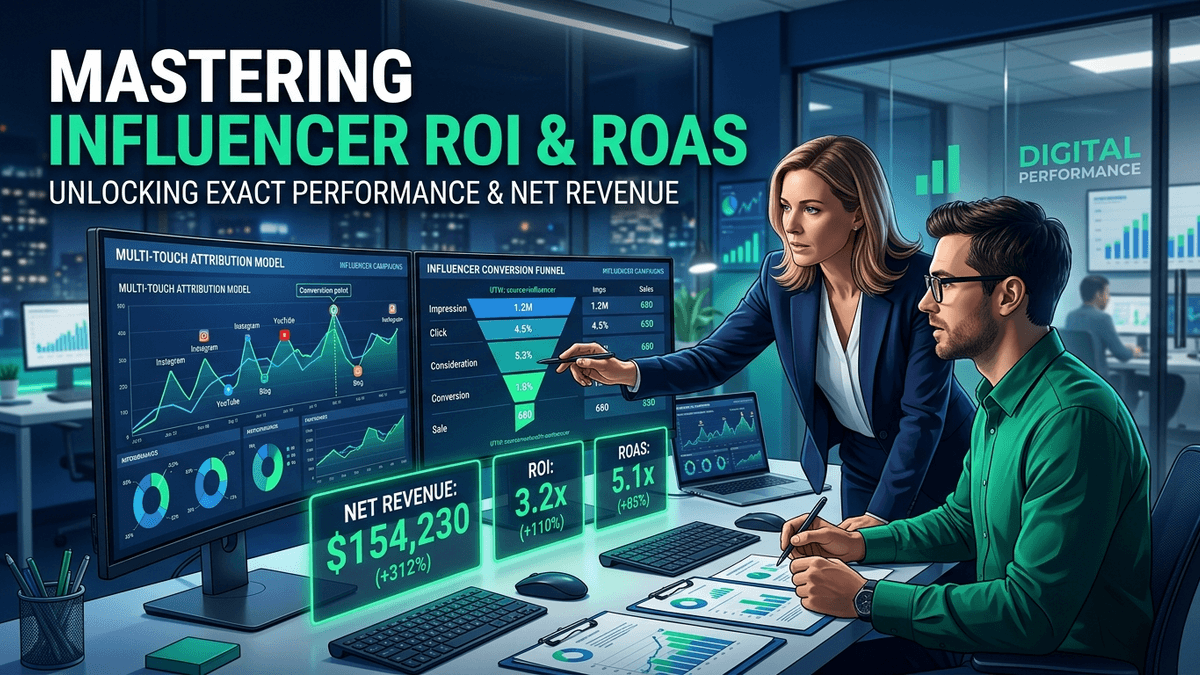
How brands calculate influencer ROAS and ROI, set up UTM, promo code and survey tracking, account for LTV and the halo effect, and report to leadership.
To measure influencer marketing ROI and ROAS, give every collaboration three tracking layers (UTM-tagged links, creator-specific promo codes and a post-purchase survey), then calculate ROAS from attributed revenue and ROI from net profit after all costs. On top of that, account for the halo effect on branded search and the long-term value of the customers each creator brings in. This guide explains the formulas, the tracking setup and how to report results to leadership.
Why influencer marketing needs financial measurement
There is a famous line in marketing: "Half the money I spend on advertising is wasted; the trouble is I don't know which half." Traditional influencer work was like that for a long time. A brand paid a well-known creator, the post collected likes, and nobody could say clearly what it added to the company's revenue.
In 2026, managing marketing on guesswork is no longer acceptable. When a marketing lead or business owner reports to the CFO, the most important evidence is how much revenue and profit each unit of spend brought back. That is the job of ROI and ROAS.
ROI vs ROAS: the difference
Many marketers use the two terms interchangeably, but they answer different questions:
- ROAS (return on ad spend) = gross revenue from the campaign ÷ influencer spend. Example: you pay a creator 10,000 TL and 40,000 TL of sales come through their links. ROAS = 40,000 / 10,000 = 4.0x.
- ROI (return on investment) = net profit ÷ total cost, expressed as a percentage. Net profit is what remains after product cost, shipping, tax, operating expenses and the creator fee have been deducted from the campaign's revenue.
ROAS tells you whether the creator generated revenue efficiently. ROI tells you whether the campaign actually made money. A campaign can show a healthy ROAS and still lose money once costs are counted, which is why both belong in the report.
Three tools every collaboration needs
1. UTM parameters on every link
Add standard UTM tags to every link a creator shares in a story or a YouTube description, for example:
https://yoursite.com/product?utm_source=instagram&utm_medium=creator&utm_campaign=summer_sale&utm_content=elif_reels
In Google Analytics (GA4) you can then see how many unique sessions each creator brought, how long visitors stayed on the site and which products they added to the cart.
2. Creator-specific promo codes
Some shoppers never click the link. They type your brand name into Google or finish the purchase on a desktop later. A creator-specific discount code, such as ELIF15, catches many of the sales that UTM tracking misses, because the code travels with the shopper.
3. Post-purchase surveys
Add one question to the order confirmation page: "Where did you hear about us?" Include the creator's name among the options. This picks up buyers who neither clicked a link nor used a code. For a deeper comparison of these methods, see our guide to influencer sales tracking with links, coupons and server-side attribution.
Hidden value: the halo effect and LTV
The return on an influencer campaign is not limited to the coupons redeemed in the first 24 hours. Mature brands also account for two less visible sources of value:
- The halo effect (indirect brand searches). How much did search volume for your brand name, and your organic sales, rise on the campaign day?
- Customer lifetime value (LTV). A customer who arrives through a creator might spend 500 TL on their first order. If that customer places four more orders over the next 12 months and spends 3,000 TL in total, the creator's real contribution is closer to 3,000 TL than to the first-day 500 TL.
Multi-touch attribution
Customers rarely buy after a single touchpoint. A typical path might look like this:
- They see the product in an Instagram Reel (first touch).
- The next day they search on Google and read your blog post.
- On the third day they click a retargeting ad and buy (last touch).
Focusing only on the last click takes credit away from the creator who started the journey. Use linear or data-driven attribution models to give the creator a fair share of the sale.
Automated tracking on Influencer Marketplace
Running all of this in manual spreadsheets is complex and error-prone. Influencer Marketplace gives brands integrated analytics panels where you can:
- Follow clicks, add-to-cart actions and orders for your campaign links live on one screen.
- See which creator delivers the most profitable ROAS and shift budget towards your best performers.
- Spot loss-making collaborations early and stop budget leakage.
A reporting template for leadership
When presenting to the CMO or the board, summarise five core metrics:
- Total budget spent
- Direct revenue generated and the ROAS multiple
- Number of new customers acquired and average customer acquisition cost (CAC)
- Number of reusable creatives (UGC) produced
- Estimated 90-day LTV return
For more reporting metrics, see our guide to influencer campaign reporting with GMV, CVR, AOV and EPC.
Frequently Asked Questions
What is a good ROAS for an influencer campaign?
It depends on your margins. A ROAS that is profitable for a high-margin product can lose money on a low-margin one, so calculate ROI after product, shipping, tax and operating costs before judging a campaign.
Do I need both UTM links and promo codes?
Yes, ideally. UTM links show on-site behaviour such as sessions and cart additions, while codes capture shoppers who buy without clicking. Together with a post-purchase survey, they cover far more of the real customer journey than any one method alone.
How do I include LTV in influencer ROI?
Tag customers acquired through each creator and follow their repeat purchases over time. Report the first-order revenue and the longer-term value separately, so leadership can see both the immediate return and the lasting contribution.
Stop spending your marketing budget blind. For data-driven, measurable creator campaigns, compare plans and create your account on Influencer Marketplace.