

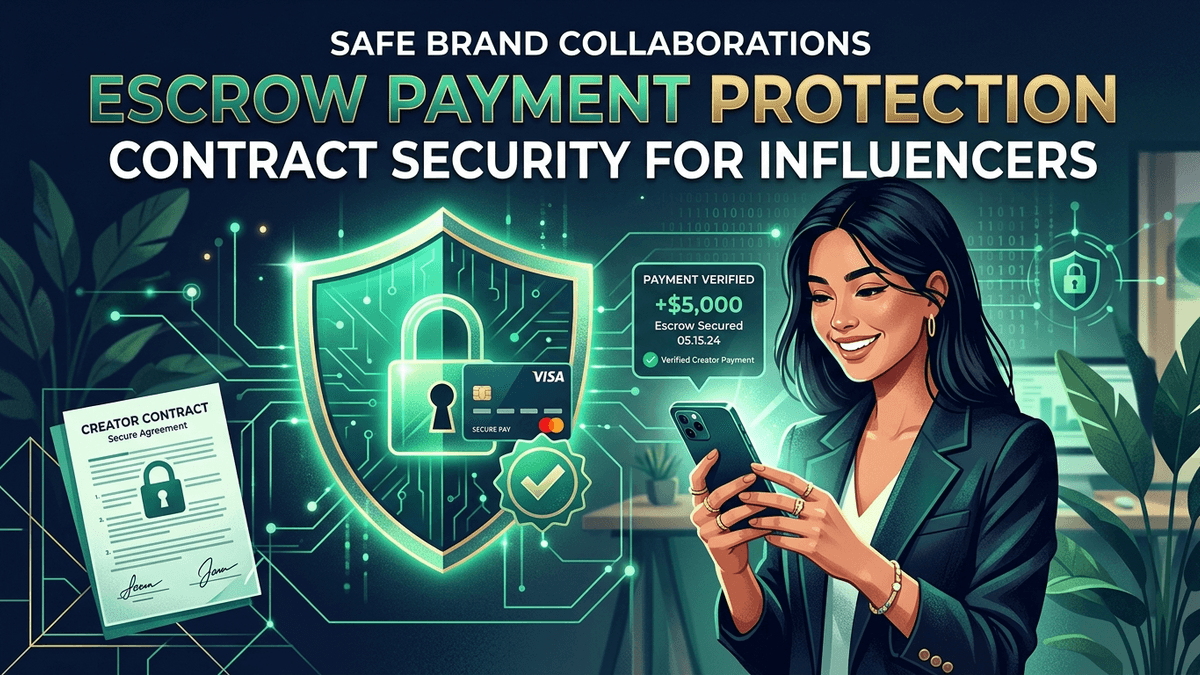
A safety guide for creators who have gone unpaid, worked without a contract or seen their content reused: escrow payments, contract clauses and scam checks.
To collaborate safely with brands, a creator needs three protections before filming anything: payment secured in escrow or guaranteed upfront, a written contract that limits revisions and prices usage rights, and the habit of verifying every offer before opening a file or link. This guide explains the most common traps, how escrow works, which contract clauses matter, how copyright protects your work in Türkiye, and how to spot fake brand offers.
Content creation is no longer a hobby. It is a profession that takes real work, creativity and time. As the industry grows, so do bad practices: brands that disappear after you have spent days filming, fees delayed for months with "we'll pay next week", endless revision requests that ruin the content, and videos used without permission on TV or in Meta ads with no end date. Protecting your work, your rights and your money is simply part of running a creator business.
1. The four most common risks for creators
The "post it now, we'll pay 45 days after your invoice" trap
Many agencies and brands are extremely attentive until the content is published. After the video goes live, payments are delayed for months, or the money never arrives because "the company went under".
Solution: never publish content without upfront security or without an escrow (pooled) account such as the one Influencer Marketplace provides.
Endless revisions
Being asked to reshoot a video five or six times over details that were never in the brief steals your time and income.
Solution: your contract should say something like: "The creator provides at most one major or two minor revisions; additional shoots outside the brief are charged separately."
Usage rights being taken
A video you agreed to post only as an organic Instagram Story can be downloaded by the brand, shown to millions as a sponsored ad or used as the face of its website.
Solution: agree and price exactly where the content will be used, organic channels only or paid ads (whitelisting or dark posts), and for how long (for example, 30 days).
Fake brands and phishing emails
Scammers imitate well-known brands and send emails asking you to "download our collaboration catalogue". The file infects your computer with malware and is used to steal your accounts. For detailed protection, read how to spot a fake brand collaboration offer.
For the full picture of professional collaboration standards, see our main influencer and brand collaboration guide.
2. How escrow payment protects your work
Escrow (secure pooled payment) is one of the safest ways to protect a creator's work. The flow looks like this:
- The brand opens a campaign.
- The budget is deposited into a secure pooled account.
- You produce the content and upload the draft.
- The brand reviews and approves the draft.
- The video goes live and the payment is transferred to your account.
In this system:
- You do not start work until the brand has deposited the money, so you know the fee is ready.
- As soon as you publish the approved content, the payment moves to your account without depending on anyone's goodwill.
- No intermediary can hold back or skim part of the agreed fee.
Before accepting any direct deal outside a platform, ask yourself who holds the money between your delivery and your payment. If the honest answer is "the brand, until it decides to pay", you are carrying all the risk.
3. Five clauses every creator contract needs
When a brand sends you a contract directly, check that it contains:
- Deliverables: how many Reels and Stories, and on which dates they will be published.
- Usage rights: how long the content will stay live, and if the brand will use it in ads, how much the extra licence fee is.
- Exclusivity: if the brand asks you not to work with competitors for, say, three months, it must pay a meaningful exclusivity fee in return.
- Force majeure: no penalty should apply in situations such as an account restriction or a health problem.
- Payment term: a binding maximum number of days between content approval and payment.
For legal templates, see our influencer contract preparation guide.
4. Copyright in Türkiye: your content is a protected work
In Türkiye, the videos, photos, audio recordings and texts a creator produces qualify as "works" protected under Law No. 5846 on Intellectual and Artistic Works (FSEK). What you hand to the brand is not ownership of the work, only a "usage licence" limited by specific conditions.
- Moral rights cannot be transferred. As the author, you cannot waive your right to be credited by name.
- Unauthorised ad use (whitelisting or dark posts). If the brand wants to run your video as a paid ad from its own ad account, the contract must explicitly define an "advertising licence fee" and an extra fee must be paid.
- Time limits. Usage rights should always be limited to a clear period, such as 30 days, 60 days or one year. Avoid signing clauses that grant a "perpetual and unlimited transfer".
5. How to spot fake brand phishing attempts
Fake collaboration emails have become one of the most common ways to steal creators' accounts. Three checks stop most of them:
- Check the email domain. Offers from generic addresses such as
[email protected]or[email protected]are fake. Established brands write from their own official domain (for example@zara.com). - Watch the file extension. If a "catalogue" arrives as a
.zip,.raror.scrfile instead of a PDF, treat it as spyware (an infostealer). Never run it. - Use two-factor authentication (2FA). On your social accounts, use app-based 2FA such as Google Authenticator instead of SMS codes.
6. A quick safety checklist before you say yes
Run through these points before accepting any offer:
- Have you verified the brand's official website and email domain?
- Is the scope (formats, number of posts, dates) written down?
- Is the fee secured in escrow, or paid upfront?
- Are revisions limited, and are extra shoots priced?
- Is ad usage priced separately and limited in time?
- Is exclusivity, if any, paid for?
- Have you kept all messages and the published links as evidence?
If any answer is "no", pause and fix it before you create anything.
Frequently Asked Questions
What can an influencer do legally if a brand doesn't pay?
In Türkiye, if you have a written contract, WhatsApp or email correspondence and proof that the content is live, you can send a formal warning through a notary and start enforcement proceedings. Court processes can take months, however, so working with platform protection from the start is the healthiest option.
What should I do if a brand uses my video as an ad without permission?
Under Türkiye's copyright law (FSEK), the content is your protected work. Notify the brand in writing immediately and ask it to stop the ad. You can also claim a retroactive fee for the unauthorised use and file for moral damages.
Which platform should I use for safe collaborations?
In Türkiye, Influencer Marketplace protects both the brand and the creator with formal contracts and pooled escrow payments processed through iyzico. The fee is secured before you start and released once the approved content is published.
Want to take brand deals without chasing payments? Join Influencer Marketplace as a creator and work with brands through contracts and escrow-protected payments.