

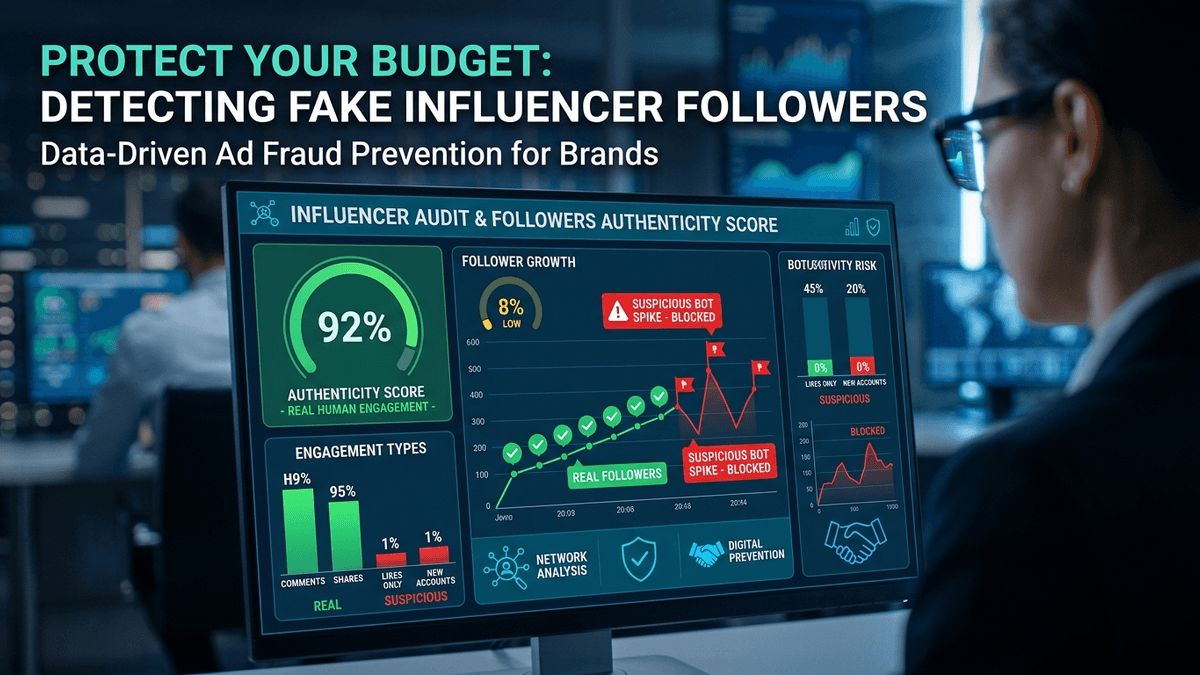
Protect your budget from vanity metrics: how to audit creator profiles, spot fake followers and bot engagement, and add contract safeguards before you sign.
To detect fake followers, check five things before you pay a creator: the follower growth curve, the engagement rate for the account's size, the quality of the comments, where the audience is located and how video views compare with likes. One odd number is not proof, but several red flags together are a strong reason to walk away.
For brands new to influencer marketing, the worst-case scenario is paying a significant fee to a creator whose followers turn out to be bots, and seeing zero sales in return. Buying followers, running automated like bots and joining reciprocal comment groups (comment pods) are, unfortunately, common manipulation tactics. An account with 500,000 followers does not necessarily reach 500,000 real people, which is why professional brands now look past follower counts to audience quality, demographic reality and organic engagement. This guide shows, step by step, how to spot fake accounts and inflated metrics before you sign.
Why fake followers hurt brands
Working with an account full of fake followers costs more than the fee:
- Wasted marketing budget: fees paid for reach that never happened cannot be recovered.
- Damage to brand reputation: being tagged under a low-quality, bot-filled profile makes a brand look cheap and untrustworthy to consumers.
- Algorithmic penalties: social media algorithms can detect content that interacts with bot accounts and suppress its organic distribution.
The five red flags of a fake audience
Work through these five checks in order when a profile looks suspicious.
1. Sudden spikes in the follower growth chart
An organic account grows steadily over time, or in gradual steps after a viral post. If an analytics tool shows an account gaining 20,000 followers overnight and then losing around 200 a day for weeks afterwards, that pattern points clearly to a bulk purchase of bot followers.
2. Abnormal engagement rates
Typical healthy engagement rates on Instagram:
| Follower range | Healthy engagement rate |
|---|---|
| 10K–50K | 2.5%–5.0% |
| 50K–200K | 1.8%–3.5% |
| 200K+ | 1.2%–2.5% |
If an account with 300,000 followers averages 200 likes per post (about 0.06%), the vast majority of that audience is inactive or fake. The opposite is suspicious too: if every post receives almost exactly the same number of likes, say 10,000 every time, an automated like bot is the likely explanation. You can calculate the rate yourself with our guide on how to calculate an influencer engagement rate.
3. Comment quality
Read the comments under recent posts manually.
- Real comments respond to the content: "I bought this dress last week. The fabric is great, but order one size smaller."
- Bot or pod comments are generic: "Amazing!", "So nice", "Awesome post", "dm me", or a lone emoji, repeated across posts regardless of the topic.
4. Audience demographics and location
If a creator who produces Turkish-language content for the Turkish market shows 40% of their audience in India, Brazil or Russia, cheap international bot packages have almost certainly been used. The same logic applies in any market: the audience's location should make sense for the creator's language and content.
5. Views that do not match likes
A Reel cannot receive 4,000 likes from 1,000 views. As a rule of thumb, views should be roughly 5 to 20 times higher than likes. Ratios far outside that range deserve a closer look.
A pre-offer audit checklist
Before you send an offer, complete these steps:
- Request Story statistics. Story views are the hardest metric to fake. Ask for screenshots of recent Story insights and a screen recording, taken in the app, of Story views and sticker taps from the last three days.
- Review audience analysis reports. Compare the age, gender, city and active-hour distributions with your product's target audience.
- Check how previous sponsored posts performed. Look under the creator's past brand collaborations: did people ask questions about the product, or did the post sink without a reaction?
- Read recent comments yourself and compare what you see with the red flags above.
Record your findings in a shared file so the next campaign does not start from zero. Our guide to influencer database quality control shows how to structure it.
Contract clauses that protect you
If you work with a creator directly, add performance and integrity safeguards to the contract:
- Minimum views and impressions guarantee: "If the content does not reach a minimum of X thousand impressions within the first 48 hours, an additional compensation Story will be published."
- Ban on artificial traffic: "Using third-party bots, pods or artificial like software to increase engagement is grounds for termination and compensation."
- Transparent statistics sharing: an obligation to send detailed analytics reports 24 hours and 7 days after publishing.
These clauses do more than create a remedy. A creator with a genuine audience will usually accept them without difficulty, and reluctance can be a useful signal in itself.
Reduce fake-account risk with Influencer Marketplace
Running every one of these checks manually for each candidate takes hours and requires technical expertise. Influencer Marketplace puts every creator who joins the platform through an advanced algorithmic quality filter:
- Only creators with real, verified audiences are listed.
- Past campaign ratings, completion success rates and transparent metrics are recorded in the system.
- With escrow payment, your budget is not released to the creator until the promised content has been delivered.
Frequently Asked Questions
What is a normal engagement rate for an Instagram influencer?
As a reference, healthy rates are around 2.5%–5.0% for accounts with 10K–50K followers, 1.8%–3.5% for 50K–200K and 1.2%–2.5% above 200K. Rates far below these ranges, or suspiciously identical like counts on every post, call for a closer audit.
What is the most reliable way to check whether followers are real?
Combine several signals rather than trusting one: follower growth history, engagement rate, comment quality, audience location and the view-to-like ratio. Then ask for recent Story statistics straight from the app, since Story views are the hardest metric to fake.
What should I do if a creator refuses to share statistics?
Treat it as a warning sign. Professional creators expect brands to ask for audience and performance data. If a creator will not share it, choose another candidate or keep the collaboration small until trust is established.
Does one red flag mean a creator bought followers?
Not necessarily. A single unusual number can have an innocent explanation, such as a viral post that brought in an unfamiliar audience. Judge the overall pattern: when several of the five red flags appear together, the risk is high enough to move on.
Put your budget behind real creators who can grow your brand, not bots. Browse our verified influencer catalogue and start your shortlist today.